Wednesday, 11 May 2016

5.8 interpret and label a diagram of an industrial fermenter and explain the need to provide suitable conditions in the fermenter, including aseptic precautions, nutrients, optimum temperature and pH, oxygenation and agitation, for the growth of micro-organisms

Okay so to start, here is a diagram...

Fermentation
Conditions...

The fermenter must be kept aseptic so only the desired microorganism grows. In order to do this, it is cleansed (usually with steam) before production takes place.

Nutrients are provided to ensure that the microorganisms always have enough food to grow.

The optimum temperature and pH is maintained and monitored with probes (connected to a screen)  to ensure maximum growth. Also, if the temperature is too high, the enzymes will denature. An optimum temperature needs to be kept to ensure the best yield.

If the process requires aerobic respiration (not beer, for example, which requires anaerobic respiration of yeast to make ethanol), there is an oxygen supply.

Agitation/stirring takes place to ensure that the microorganisms, nutrients and temperature are evenly distributed.

image credit: BBC

5.7 undersand the role of bacteria (Lactobacillus) in the production of yoghurt

Lactobacillus is the bacteria that ferments milk (into yoghurt) in yoghurt production. This is the process...

- All equipment is sterilized in order to kill off any unwanted micro-organisms.

- the milk is heated to 72° for 15 seconds (pasturisation) in order to kill any germs in the milk.

- the milk is cooled

- The bacteria 'lactobacillus' is added.

- the mixture is incubated at around 40° in a fermenter. This is where the bacteria ferment the lactose sugar in the milk, forming lactic acid

- The lactic acid causes the milk to clot, causing it to solidify and turn into yogurt.

- Any flavourings/colourants are added

- the yogurt is packed

5.6 describe a simple experiment to investigate carbon dioxide production by yeast, in different conditions

When yeast respires aerobically, it produces carbon dioxide as a bi-product. Here is how to measure the effect of changing temperature on carbon dioxide production from yeast...


- mix together some suger, yeast aand distilled water. Add this mixture to a test tube

- attatch a bung with a delivery tube. Attatch the other end of the delivery tube to a test tube of water

- Put the tube containing the yeast/water/sugar solution in a water bath at 10°.

- leave to warm up for 5 minutes and then count how many bubbles are produced in one minute

- repeat with 4 other test tubes, one at 15°, one at 20°, one at 25° and one at 30°. You should also do one at room temperature as a control

- plot results in a graph and compare/find patterns/anomalies

should all go well, you should conclude that as temperature increases, the rate of respiration (and therefore amount of bubbles) should increase. However, if you have done a water bath past optimum temperature for the enzymes (as respiration is controlled by enzymes), then there will be very little/no data for this tube.

NOTE: You can use the same apparatus but measure the effect on different concentration of sugar, for example, by keeping the water bath the same temp but adding more/less sugar to each tube. the same can be done with volume of water and/or concentration of sugar solution etc

5.5 understand the role of yeast in the production of beer

When yeast respires anaerobically (without enough oxygen) it produces ethanol/alcohol as a bi-product. In beer production, yeast respires anaerobically. It is the ingredient in the production of beer that makes the alcohol, it ferments the sugars into alcohol.

5.4 understand the reasons for pest control and the advantages and disadvantages of using pesticides and biological control with crop plants

Pesticides/pest control kills insects/microorganisms/mammals that feed on crops. they are useful as they are very effective. However, they are poisonous to humans so must be used carefully around foods etc (e.g. growing carrots) and some pesticides are harmful to other wildlife.

Biological control is an alternative to pesticides, it involves using other organisms to control pests (e.g. introducing hoverflies to an area to reduce the amount of aphids, as aphids kill hoverflies). This has a longer lasting effect on the crop/area than pesticides do and is less harmful to the ecosystem. However, it can cause problems. for example, the introduced species could become uncontrollable and their predator would have to be introduced to control them. It can also take longer (potentially).

5.3 understand the use of fertiliser to increase crop yield

If plants don't get enough nitrogen, potassium or phosphorus, their growth and other life processes could be affected.

These elements are naturally found in the soil, however, they could be lacking due to previous crops using them up. All fertilisers do is replace them in the soil, so the plants can grow very well.

5.2 understand the effects on crop yield of increased carbon dioxide and increased temperature in glasshouses

Okay so, I mainly covered this, along with other factors, in point 5.1, but here it is again...

If carbon dioxide is increased, the rate of photosynthesis will be increased. Meaning more photosynthesis will occur each day, meaning a bigger crop yield.

If temperature is increased, plants can grow throughout the winter and don't die of frost etc. This also lowers the rate of transpiration (as there is a lower concentration gradient inside vs outside the plant leaf so the rate of transpiration is lower).

5.1 describe how glasshouses and polyethene tunnels can be used to increase the yield of certain crops

Glasshouses and polyethene tunnels/polytunnels help to create the ideal conditions for plants, thus increasing the yield (how much grows) of a crop. Some ways they create the perfect conditions are...

- The plants are enclosed, meaning they are at no/a significantly lower rick of pests and diseases.

- Artificial light can be supplied which will increase the time per day a plant is photosynthesizing

- The suns heat can be trapped (particularly in glasshouses). This keeps the plant warm. In winter it can stop the plants from being damaged by frost etc

- As it is an enclosed space, farmers can increase the level of carbon dioxide in the glasshouse/polyethene tunnel. They can do this by burning a paraffin lamp etc (combustion fossil fuels gives carbon dioxide). This further increases the amount/rate of photosynthesis the plant endures.

All of the above increase the yield of a plant.

Tuesday, 10 May 2016

4.17 understand the effects of deforestation, including leaching, sol erosion, disturbance of the water cycle and of the balance in atmospheric oxygen and carbon dioxide

Leaching
Trees leach nutrients when they are alive, but return nutrients to the soil when they die. When trees are cut down, nutrients gets leached but not returned, resulting in infertile soil.

Soil erosion
When trees are removed, soil can be washed away by rain etc as tree roots hold soil together (but there will be no tree roots, as there will be no trees).

Disturbance of the water cycle
Trees take up water, when they are cut down, water runs straight into rivers, causing flooding. also, the local climate gets drier as there is much less transpiration occurring.

Disturbance of the balance of carbon dioxide and oxygen
When trees die, carbon dioxide is naturally released. When they are burnt, all the carbon dioxide is released at once. alternatively, if wood is used in furniture etc, the carbon is stored and not released, disrupting the carbon cycle.

Fewer trees means fewer photosynthesis means less oxygen.

4.15 understand the biological consequences of pollution of water by sewage, including increases in the number of micro-organisms causing depletion of oxygen

Like fertilisers, sewage also contains phosphates (from detergents) and nitrates (from faeces etc). If these are leaked into rivers, eutrophication occurs.

NOTE: Point 4.16 my help for understanding

4.16 understand that eutropication can result from leached minrals from fertiliser

Nitrates and phosphates can leak from mineral fertilisers that are put on fields. If it rains, they are easily leached into rivers and lakes. this results in eutrophication. Basically...

- The extra nutrients causes algae to grow super fast. This blocks out the light
- Plants in the river (before the algae) can not photosynthesise due to low light. They die.
- With more food (dead plants) available, microorganisms living in the water rapidly increase in number and deplete/use up all of the oxygen in the water.
- Organisms, like fish for example, that need oxygen, die.


4.14 understand how an increase in greenhouse gases results in an enhanced greenhouse effect and that this may lead to global warming and its consequences

Heat from the sun is naturally radiated off the earth and into space. Greenhouse gases naturally keep in some of the heat (otherwise we would all die of cold, basically). However, increasing the amount of greenhouse gases is blocking the heat from escaping (known as the greenhouse effect). effectively, this heats up Earth, which is global warming.

Consequences of global warming include climate change (e.g. change in rainfall pattern)

4.13 understand how human activities contribute to greenhouse gases

Okay so basically...

Contribution to carbon dioxide - Car exhausts, industrial processes (burning of fossil fuels etc), cutting down of trees

Contribution to methane - rice growing, cattle rearing

Contribution to nitrous oxides - fertilisers, vehicle engine, industrial engines

CFCS - all man-made

4.12 understand that water vapour, carbon dioxide, nitrous oxide, methane and CFCs are greenhouse gases

NOTE: You may be asked where the greenhouses originate from. Well, its not in the spec but it was in the 2015 paper so just to be safe I have included the info (its in red).

Greenhouse gases are bad as they trap heat from the sun in the earths atmosphere. Examples of greenhouse gases include...

- Water vapour
- Carbon dioxide (deforestation, industrial processes, car exhausts)
- Nitrous oxide (fertilisers, vehicle engines, natural release from bacteria)
- Methane (rotting plants, rice growing, cattle rearing)
- CFCs (NOTE: CFCS are man-made chemicals, they are basically not produced anymore but some still are and are leaking from old products that contain them)

4.11 understand the biological consequences of pollution of air by sulfur dioxide and by carbon monoxide

Sulfur dioxide
When fossil fuels are burnt, sulfur dioxide is released (from sulfur impurities in the fuel). When it mixes with rain clouds is forms acid rain (dilute sulfuric acid). This kills fish and trees as it causes lakes to become more acidic and can damage leaves and release toxic substances from the soil, meaning it is hard for the tree to take up nutrients from the soil.

Carbon monoxide
When fossil fuels are not burnt with enough air (incomplete combustion), carbon monoxide is produced. this is a poisonous gas and binds to haemoglobin in red blood cells, preventing the red blood cells from carrying enough oxygen to your muscles.

4.10 describe the stages in the nitrogen cycle, including the roles of nitrogen fixing bacteria, decomposers, nitrifying bacteria and denitryfying bacteria (specific names of bacteria are not required)

Firstly, here's a diagram...


Okay so...

nitrogen fixing bacteria - this turns atmospheric nitrogen into nitrogen compounds (in the soil) that plants can use

decomposers - turns proteins and urea (from plants and animals) into ammonia

nitrifying bacteria - this turns ammonia into nitrates

denitrifying bacteria - this turns nitrates back into atmospheric nitrogen gas

The process repeats.

NOTE: Some of these bacterium live in the soil and some live on the root nodules of plants.

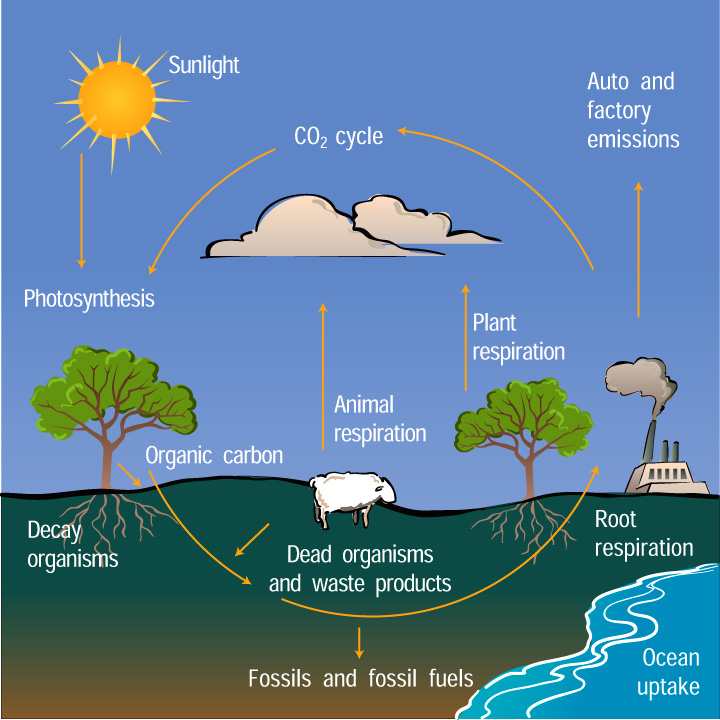
4.9 describe the stages in the carbon cycle, including respiration, photosynthesis, decomposition and combustion

To start, here is a diagram...


Okay so...

Respiration - breathing basically. this releases carbon dioxide back into the air.

Photosynthesis - carbon is taken in (by the plants)

Decomposition - when plants and animals die, decomposers decompose them. this introduces carbon back into the soil

Combustion - things like wood and fossil fuels are burned. This releases carbon dioxide back into the air

The carbon dioxide in the air is then taken in by plants and the cycle continues(this is why plants are so important)

4.8 describe the stages in the water cycle, including evaporation, transpiration, condensation and precipitation

Firstly, here is a diagram...


Okay, so...

Evaporation - this is where water (from  the ground) gets warmed (usually from sunlight). When this happens, the water molecules gain energy and they start to move lots more, eventually they turn into a gas.

Transpiration - all transpiration is is evaporation from plants/leaves

Condensation - When the warm water vapour is carried upwards (convection currents). However, the higher you go the colder it gets. The water vapour eventually cools down and condenses, forming clouds

Precipitation - a fancy name for rain/snow/hail

4.7 explain why only about 10% of energy is transferred from one trophic level to the next

This is mainly explained in point 4.6, but I will cover the main points again...

Much energy is lost so not all energy an organism takes in is conserved until it dies and then transferred onto he next trophic level when it is eaten. the main causes of energy loss are...

- Heat energy
- Energy needed for the 7 life processes
- Energy in indigestible foods (e.g fibre) is not 'absorbed'

this results in around 90% of the energy being used, so only 10% is passed onto he next trophic level.

4.5 understand the concepts of food chains, food webs, pyramids of number, pyramids of biomass and pyramids of energy transfer

Food chain
A food chain shows the flow of energy up the food chain. It can only show one organism at each trophic level, also you cannot tell whether the organism is feeding at more than one.


Here is an example of a food chain...
Food chain picture example


Food web
A food web gives a better understanding of a certain ecosystem by linking several animals within a habitat showing which organisms consumes which etc. A food web basically just shows multiple different food chains, that are all linked together. They show multiple different trophic levels including multiple prey and multiple predators. This means an organism has the potential to be a secondary or tertiary consumer at the same time.

Here is an example of a food chain...

Example of a food web using birds

Pyramid of numbers
A pyramid of number shows the number of each organism (of each trophic level of a certain food chain) by the area of the block in the pyramid. E.g a large block is lots of that animal, a little block means few of that animal.

Here is an example of a pyramid of numbers...


Pyramid of biomass
A pyramid of biomass is a bit like a pyramid of numbers, only it represents the dry mass of each consumer (and producer), again, by the area of a pyramid block.


Here is an example of a pyramid of biomass...

Pyramid of energy
A pyramid of energy, again looks like a pyramid of numbers/biomass, but it shows the transfer/flow of energy through the food chain.


Here is an example...


NOTE: The amount of energy transferred decreases by 10% each time, this is important (this is explained in 4.6).